Health and Wellness

Improv for Confidence: The Blog

Exercises, tips, and stories to boost confidence, collaboration, and communication in the workplace.


Improv is weird and silly and unpredictable, so you get to practice being thrown off and messing up, so you can practice thinking on your feet and recovering with aplomb. And the best part is, you don’t have to do it alone.

You can’t help but feel more confident going into a situation knowing that you’re part of a team, and you can handle things not going exactly as planned.

Browse the categories below to learn how to fear less, and confidence more:


“Yes, and” you’re successful!

improv training team building business success

Wanna feel successful? Realize your days are already filled with successes.


Gonna get all High School Valedictorian speech and say, Oxford Dictionary defines “success” as: the achievement of a desired result or outcome; the accomplishment of an aim or purpose.


Which means, by definition, you could aim to brush your teeth, accomplish brushing your teeth, and that is a success. Then strut around knowing you’ve already been successful today!


To which you might think, “Technically yes, BUT…”

But brushing teeth isn’t a big enough achievement.

But it doesn’t make money.

But it’s not growing as a person.

But I can’t brag about it on social media.

But but buuuuut…


To which I say, remember the power of “Yes, AND.”


Making millions of dollars is a measurement of success.

Yes.

ANNNND… so is getting out of bed. (It’s so warm and comfy!)


Maybe you didn’t climb Everest today (lazy), but you did go for a walk. That might not be considered “worthy” of other people lifting you up and chanting your name, but it is worthy of YOU celebrating.


YES, celebrate the big achievements, AND the little ones. Clock enough little ones and they’ll start to feel big, too.


“I wrote a book today!”

“Yes! And I made a sandwich!”

“Look at us, just two successful people!”

Use your First Time Forgiveness™

improv anxiety forgiveness love support

Even perfectionists need to give themselves some leniency the first time they try something new. First time you ever sit down at a piano, the expectation can’t be that you instantly play a perfect concerto. Second time, yes, obviously you should be concert-ready, but first time?! There’s gotta be some “First Time Forgiveness.”

Now, keep FTF in mind when I say, every single conversation you have in life, you’re having for the first time. Even conversations you feel like you’re having for the 100th time, it’s never happened in this exact context, with these exact words. Some part of it is always new.

Everything we do has some degree of newness. Some percentage of it is happening for the first time. And the percentage that’s happening for the first time needs to come with FTF.

Let’s say you go to your first improv class. Congrats, btw. And you and the class play the improv game where each person takes a turn adding one word to the story. Afterwards, you think, “That was hilarious, improv is amazing, and the story was fun, but wasn’t… perfect.” But hey, it’s your first time ever, so you can’t be too hard on yourself.

Then you play the same game again, but this time going in reverse order of the class. Second time, so you gotta think you’ll be better than the first time, but technically it is your first time going in this order.

Then you play it again, but this time in teams of two. Third time overall, but first time in pairs.

It could be your 100th time playing it, and something will always be different, new, the first time.

So when it doesn’t go perfectly (because things don’t, and that wouldn’t be as fun anyway) and you want to judge yourself, you have to factor in FTF. Instead of beating yourself up thinking, “I should be 100% great at this by now,” think, “I should be 80% great at this by now. But I should also go 20% easy on myself because it’s the first time playing it with these people, in this order, with this instructor, in these shoes… (or whatever is new this time).”

If there’s anything you’re being hard on yourself about right now, take a moment to think about what percentage was new/different this time. “I’ve done this presentation a thousand times… but never at this venue.” “I’ve met new people before… but never this person.” “I’ve done backflips plenty of times… but not usually with the whole office watching… anyway, here goes!”

Even if it’s only 1% different. Give yourself that 1% forgiveness for not being perfect. After all, you can’t be expected to be perfect, you’re living this exact moment for literally the first time.

26 Ways Improv Can Help You In 2026

improv new year's resolutions 2026

Improv helps with everything!

Did you write a list of New Year’s Resolutions with the plan to do a bunch of different tasks to achieve those goals? Simplify, man! Just do improv!

Improv helps you…

1) Laugh more.

2) Play characters that don’t have your problems.

3) Get out of your head.

4) Be silly and be okay being silly.

5) Practice failing and recovering.

6) Use your imagination to create wonderful things.

7) Tell fascinating stories.

8) Move your body in interesting ways.

9) Think differently and be okay with others thinking differently.

10) Adapt to the unexpected.

11) Let go of expectations.  

12) Surprise yourself! (Improv gets you doing things you had no idea you could do.)

13) Be open to the ideas of others.

14) Love and support the ideas of others.  

15) Connect with people on a deeper level.

16) Judge less. Yourself and others.

17) Accept things as they are. It’s not settling, just not denying.  

18) Take yourself and any “failings” as little less seriously.

19) Trust yourself more. You can do this.  

20) Feel more confident.

21) Make bold choices. (Or make any decision, then boldly follow through.)

22) Make new friends.

23) Know that you are enough.

24) Release stress from your body and mind.

25) Focus on all the little moments of joy.

26) Play!

If you like the sounds of that, reach out to book an improv workshop today!

Top 5 New Year’s Resolutions for 2026 (and how improv can help)

improv training team building confidence fireworks joy

#1 Stress less

A popular resolution these days. Because, let’s be honest, the world is messed up. And I mean messed up. Like, don’t even get me started on… wait, what were we talking about? Oh, improv.


While improv might not be able to “fix” the world, it can help reduce stress with movement, creativity, and laughter, and build stress resilience by practicing different ways to respond to things. Also, it’s fun. And it’s nice to have fun.


#2 Be less anxious

This one’s quite personal to me, it was my #1 resolution for over a decade straight. Anxiety kept me from enjoying life. Hell, it kept me from participating in life. I don’t need to go into how much anxiety sucks, you get it. Let’s move to the helpful part.


Improv can lessen anxiety by building a safe space to play and feel joy. And can increase confidence knowing you can handle the unexpected.


#3 Get better at public speaking

Being able to present yourself in front of others is a big part of today’s work world. And friend world. And dating world. It’s just a good all ‘round skill.


With improv, it’s not about learning how to speak “perfectly,” but learning to mess up royally, recover with ease, and continue with confidence.


#4 Be more confident

Wanna be one of those super confident people strutting around knowing that whatever the world throws their way, things will turn out okay? I mean, the strutting part is optional, but with improv, you get to practice making bold choices, playing confident “characters,” and learning to think on your feet with such aplomb that you’ll never seem thrown off.


#5 Be more creative

Remember when, as kids, we could just slap paint on a piece of paper with our hands and call it art? Then remember when we learned to judge ourselves and others and find flaws in everything? Now’s your chance to unlearn all of that judgement, and give over to the wonderful world of “Yes, and!”


Bonus #6 Spend less time on social media

There isn’t really a specific improv workshop for this, but improv takes place not on a phone with other humans who are also not on their phones. Sounds scary, I know, but you’ll be having too much fun to notice.

Start the year strong with improv!

How to Measure “Soft Skills” in Improv Training: Increased Confidence

Building Boldness with Improv


Let’s say your goal is to increase your team’s confidence, so you book them for some training. After the training, how do you know they’re now more confident? The obvious answer would be, well, are they acting more confident? So let’s define what that means.

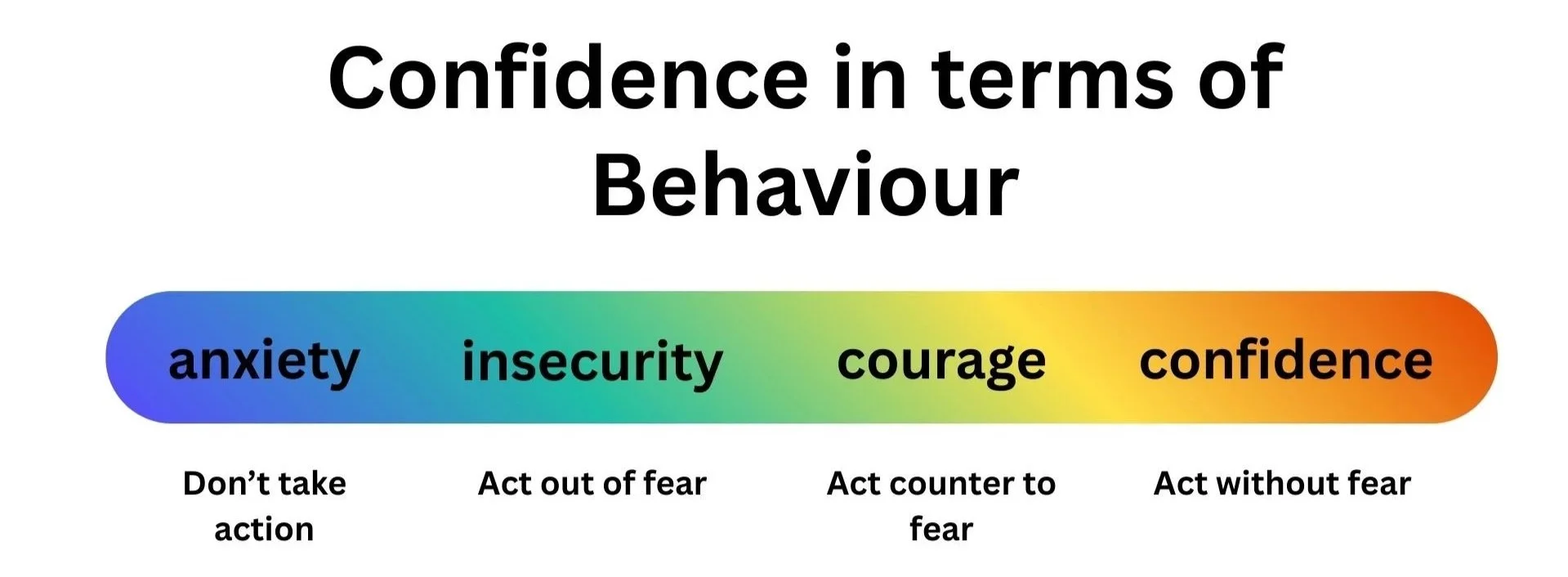
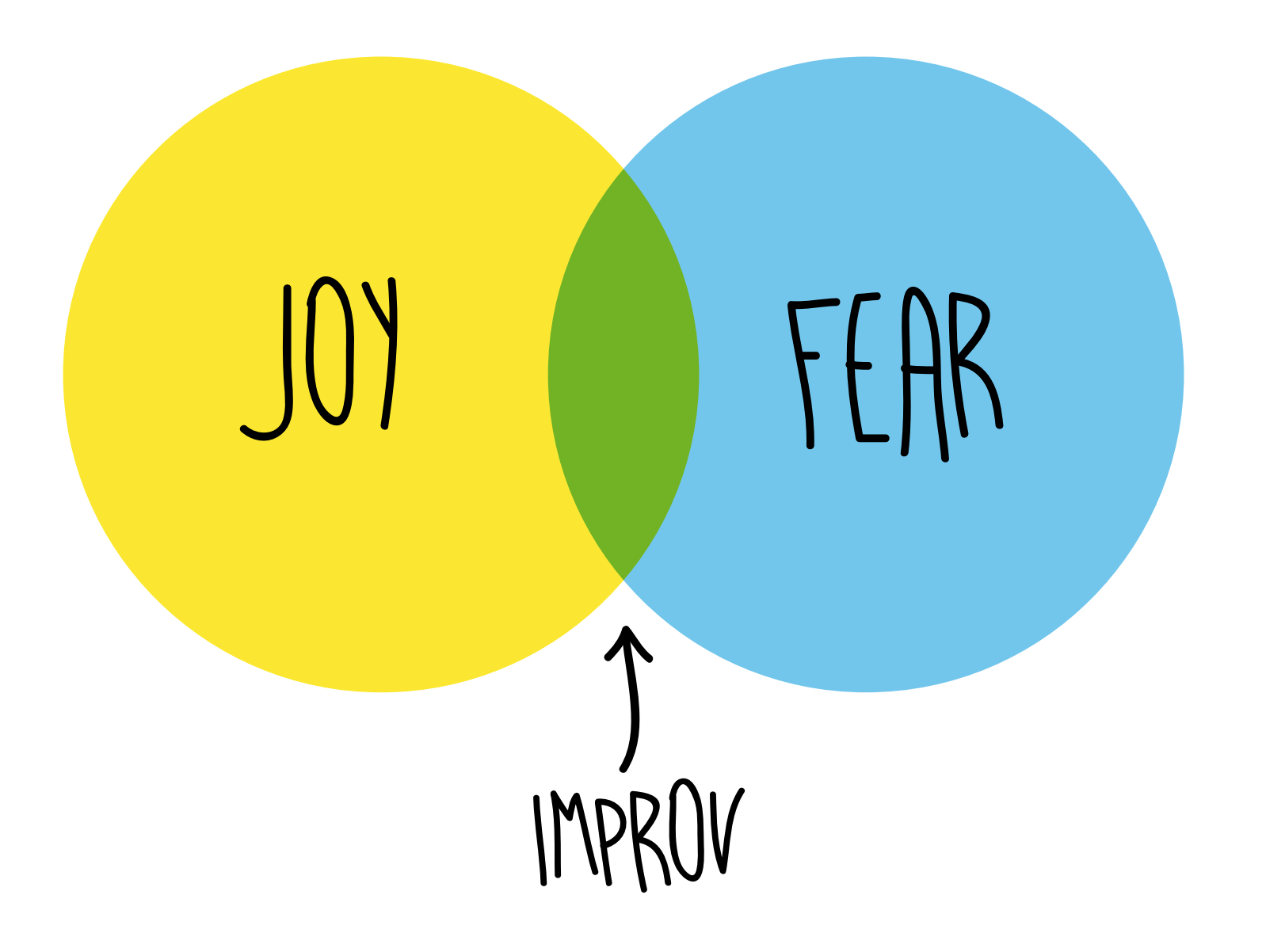
It’s most likely not going to be a complete transformation. Like, if they never used to speak up in meetings at all, I doubt they’ll suddenly present their ideas through interpretive song and dance. Think of behavioural change more in terms of a sliding scale. And you can gauge an increase in confidence by having one simple measurement to compare against: Fear.


On one end of the scale, you have anxiety (stress, burnout, overwhelm) and on the other end we have confidence (with a couple stops along the way).

improv training confidence success scale

So, to measure the success of the workshop, you need to know where you’re starting from. How scared are they to do things right now, and how much less scared are they to do those things after the workshop? The goal being to slide up the scale.

When it comes to “acting” more confident, here’s an example of how their actions could look along The Confidence Scale™:

improv confidence building training

Again, it’s a sliding scale. Sometimes they might act courageous, but under pressure switch to panic and yell, or shut down completely. No judgement, we all feel it. Improv For Confidence™ workshops are just about sliding a little further on the scale (not judging people for where they are now).

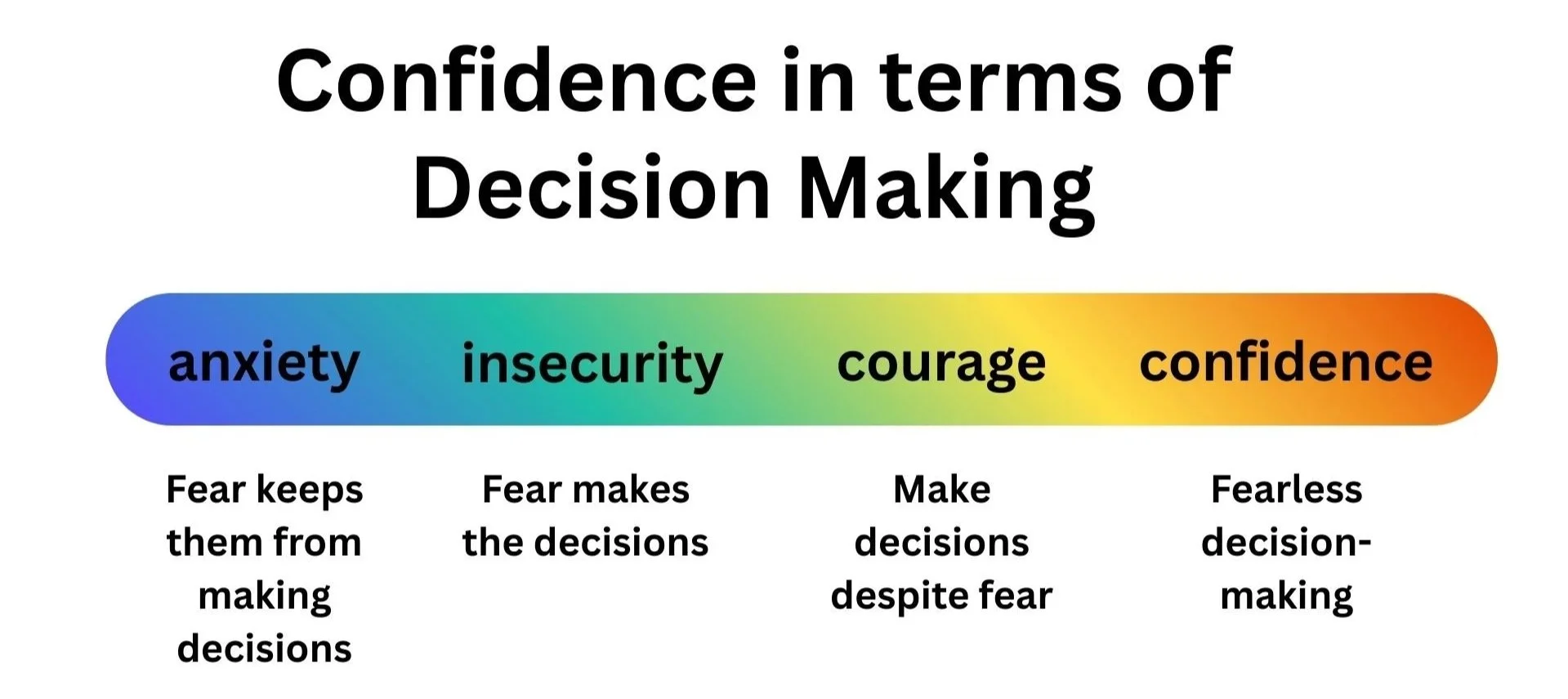
Here’s an example of how to gauge their current confidence when it comes to a key leadership skill:

Unfortunately, many people get stuck at the insecurity stage, and make fear-based decisions (what they think the client would want, what they think would stay within budget, what would be safest, least likely to get them in trouble, etc.) but try to make themselves and others believe they’re confident.


This might not be the most scientific as far as a direct measuring tool, but you can often tell when decisions are made out of fear/insecurity and when they’re courageous/confident. And while fear can help motivate a decision, it’s not always the best one.

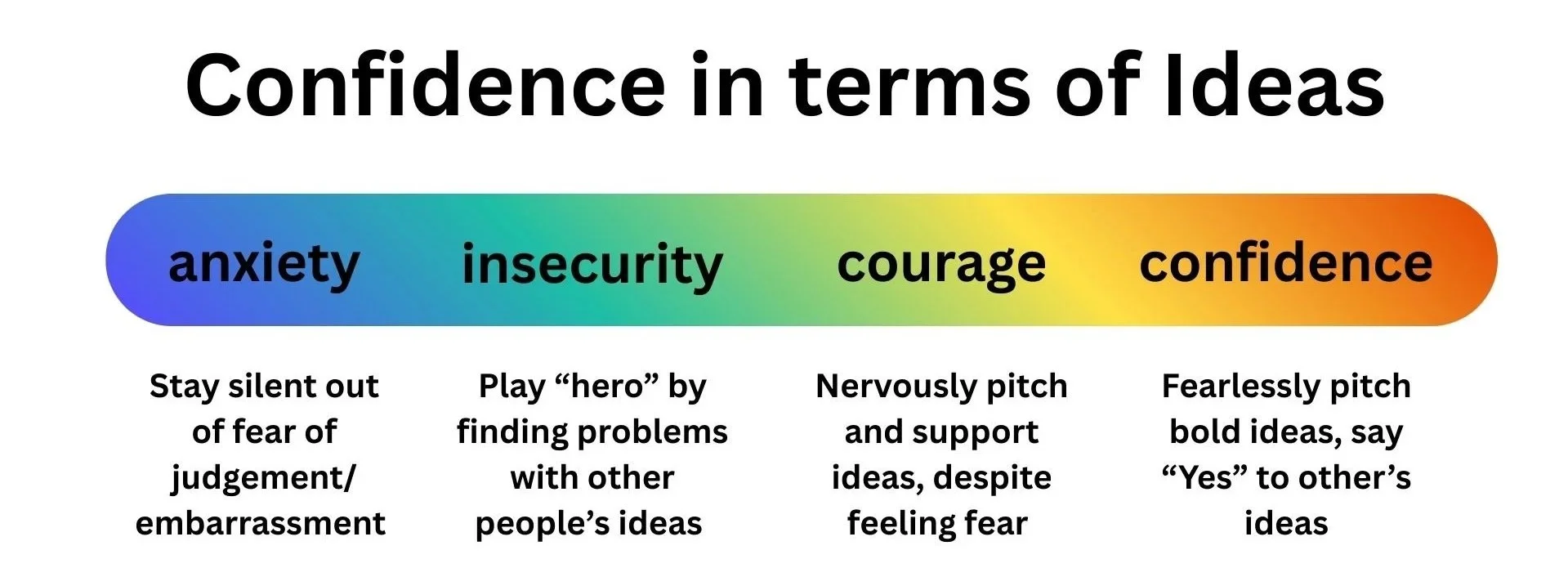
What to look for during the next brainstorming session:

improv confidence team building training creativity

You’ll know there’s an increase in confidence by the amount of “Yeses” versus “No’s.” The voice of reason, devil’s advocate, whatever you want to call it, is in reality, just fear talking. You want people with the courage to explore ideas, not shoot them down before they start.


In short, here’s how you measure success when training the “soft skill” of confidence.

  1. Get a sense of where they are now on The Confidence Scale™.

  2. Do an Improv For Confidence™ workshop (or a few).

  3. Mark where they are after.

Our goal is to move them further along the scale. To change their belief in themselves, so they call the shots more than letting fear lead the way.

Improv will help you build a more confident team. Which, as you already suspect (enough to be looking into confidence training), and will soon see, is definitely a good thing.

What happens in an improv team building workshop?

improv team building workshop activities toronto

Great question!


Quick caveat, each workshop gets customised based on your team’s needs and goals, the number of people, how long we have, etc., so what happens can really be anything. But this general outline can be a good starting point to get a sense of what a session could look like.


Bonus caveat, this outline isn’t going to sound nearly as fun as improv actually is. Just know that behind all skill-building talk, the workshops will always have a focus on fun and laughter.  

Let’s begin.


1) INTRODUCTION


We’ll do a quick intro on improv, the idea of “Yes and,” and the benefit of learning/honing this skill. At the start of any workshop, most people just want to know two things: what’s this about, and how it’s going to help me?


With improv, I’ll also address two other big questions: “Will I have to be funny?” and “Will I be put on the spot and look silly… and have to be funny?” No and no. These improv exercises are focused on connection and collaboration, building stories and ideas together. With everyone participating at the same time, and nobody is singled out or has to be “good at it.”


2) WARM-UP EXERCISES


A few simple improv games to get people moving their bodies into a sense of play. Games so easy there’s no fear of “messing it up.” Because even though I mention not needing to be good or funny in the introduction, there might still be some fear of looking silly in front of your peers.


Eg. “Yes Let’s!”

Someone calls out an activity, like “Let’s play basketball!” and everyone practices being open to other people’s ideas by responding with an enthusiastic “Yes! Let’s!” then playing imaginary basketball together.


3) SKILL BUILDING EXERCISES


This is where we explore the meaning of “Yes, and”, and how using it in work interactions makes for better team communication, connection, and collaboration. 


Again, which exercises go here can be determined by the type of team and their goals, whether overall communication skills, listening skills, conflict resolution, presentation skills, creativity, leadership and management skills, and so on.


Eg. “Word at a Time Story”

In smaller groups and/or pairs, each person takes turns adding just one word to the overall story, so nobody has too much control over where the story goes. Trains listening, being open and judging less, being present, letting go of control and thinking collaboratively.


4) PERFORMANCE EXERCISES


This is the section where not everyone is participating at the same time. Some are performing while the rest are their audience. A chance to put your newly honed improv skills into practice. This part is closer to what you might see on Whose Line Is It Anyway?


One small group at a time (unless it’s specifically a presentation skills exercise, then you might be alone for this part) will play an improv game on the “stage area.” The games are designed for success, aka ease of laughs and joy.


Eg. “The Show Must Go On!”

Five participants act out a 1-minute scene improvising a conversation between five different characters. Then we repeat the same scene 4 more times, each time removing one participant, but not their character’s line. Eventually, one participant has to recreate the whole first scene by playing all 5 characters. (If this seems hard, reminder, we do build up to this.)


5) Q&A


Throughout the workshop, I’ll explain how to do each exercise, but also how it applies in the real world. With that said, if there are still any questions, we leave time at the end for discussion.


And then, one last, fun, everyone moving together cool-down exercise.


--


That’s about it. Again, this is just a general outline, and can be adjusted to anything you need. We’re improvisers, after all.


One workshop we did for The Toronto Raptors staff and management, we broke them into 8 different “teams” and did a bracket-style competitive improv tournament, so there’s really no limit to what an improv team building workshop could look like.


But if you like this starting point and want to talk more, reach out.

Improv for Anxiety for Business: What if my staff is terrified of an improv workshop?

A lot of times when I’m working with a company to plan their improv workshop, it’ll be brought up that amidst all the excitement and buzz for the event, there’s also a fair amount of trepidation. Meaning, some of their coworkers/staff have come up to them and said, “Do I have to do the improv?” “Will we have to go on stage?” “What if I’m not funny?” All the fun stuff our brains think about.


So they ask me, do you know how to handle a workshop when some (or most) of the people are terrified and don’t want to be there? And I’ll say, honestly, that’s my specialty!


I go into corporate workshops almost the same way I go in to teach an improv for anxiety class. Knowing that there’s a mix excitement and nervous energy. And quickly explain that improv isn’t about being individually funny or showing off, it’s about connection and collaboration, and building ideas together without judgement. In other words, goal #1 is to create a safe space.


For any adult, the idea of “being silly” can be scary. Most of us have been told off for “goofing around” since we were kids. Parents, teaches, managers all telling us to be more serious. Add to that the fact that during the workshop you’re still technically “at work” and depending on who participates, you might be acting goofy in front of your boss(es).


But there’s no reason we can’t do our jobs seriously AND also enjoy them. We can be talking to coworkers about an important project, and yet still enjoy the conversation. Humans instinctively want to play and connect and enjoy life, it’s just been a while since we felt “allowed.”


Improv is as a place where you’re allowed to have fun. And to put everyone at ease, no, I’m not gonna start the workshop with “Whose Line Is It Anyway?” style scenework, where two people have to be funny while everyone else watches. Sure, I could probably find two volunteers willing to do it, but I can tell you the anticipation/dread from the people “waiting their turn” won’t be fun. As much as improv is about stretching comfort zones, it ain’t about breaking them.


Think of improv as a series games and exercises designed to get people playing together like kids used to during recess. Moving around and being silly, connecting with your inner child, your free to be creative side, your state of play.


Because yes, an improv workshop is going to help everyone think faster on their feet, adapt to change, listen and communicate more effectively, feel more confident, and all that good stuff, but one of the main keys is that you’re laughing while learning. So it’s important that they’re having fun. Because it’s easier to play and laugh when you’re not so scared. 

How Fortune 500 companies use improv to build their leadership skills.

PART 2: Improv helps you care about others.

improv leadership skills team building activities toronto

In Part 1, we talked about the importance of the ability to make decisions. Now we’re talking about which decisions to make. And ideally, they’re decisions that will help the team you’re leading.


Imagine you’re on stage with someone. And they start the scene by saying, “Well, I hope you’re happy now.” In Part 1 we talked about all the decisions that need to be made to help build the world out of imagination. What did you do? Who would ask you that? What’s the context? Etc. All decisions you could make by going in your head and rummaging around for answers.


Now let’s shift outside ourselves and focus on them. How did they say it? Annoyed? Angry? Almost laughing? How are they looking at you? How close/far are they standing? What do they want from you? Like is it funnier TO THEM if you say that you are happy now?


In other words, improv teaches you to care about your scene partner(s). In real life, you can think of your “scene partner” as anyone you’re having an interaction with. Be present with them. What are they feeling? What do they want out of this conversation?


Humans tend to think other people think like they do. And often get frustrated when they don’t. But with improv, you quickly learn to be open to different ways of thinking, and even more important, appreciate different ways of thinking. So in a leadership position, you learn it isn’t about teaching your staff to be more like you, or that you’re the only one who knows how to do it “right,” but appreciating people for who they are, and what they can bring to the table.


In other words, you learn to let go. Leading isn’t about control. At first, out of fear, people often try to steer conversations/situations to where they want it to go, or to where they think it should go. But it’s hard to control others, and make them say or do everything you want. It’s frustrating. So with improv, you give up control, and the next thing you know, you’re sharing an experience where the collective ideas are way better than your individual ones would’ve been.


In conclusion, if you want to care more about others, a key leadership skill, you should definitely try improv.

Help! I’m in charge of organizing my company holiday party and need some fun activities in Toronto.

improv team building activities fun company holiday party toronto

So you’ve been put in charge of finding something fun to do for the company holiday party. Which means a quick google of “something fun to do for a company holiday party.” Or, more likely these days, you ask chatGPT, “What’s a fun thing to do for a company holiday party?”


And you got your secret santa, cake decorating, trivia night, live band, DJ, comedy show… Comedy show? Interest piqued. Like, someone will come in and say funny things and we’ll all laugh. That sounds fun.


But what if I wanted more fun? Like, us being more involved somehow. Well, then you could make it so that the staff is part of the show. Heck, the staff could be the show!


Yeah, I’m talking about improv. (As always.)


Book us for your company holiday party and group of expert improvisers (that’s a thing) will host and guide your team through a series of fun improv games designed to get laughs. Yes, they’ll take turns performing comedy for each other.


In essence, it’s like having your own episode of Whose Line Is It Anyway?


What more could people want?! Probably some booze, people will probably expect booze. And food. And maybe some decorations. A music playlist? Okay, still a lot to think about, but hey, at least you’ve got the main part of the event covered. Staff Improv Show!

Top 3 Reasons your Staff hates Team Building Activities

improv team building activities toronto

#1: They don’t want to look stupid.

Most team building exercises are designed to be fun. Which sounds great to the person booking, and potentially terrifying to the people expected to have this so called “fun.” Fun sounds silly, and they don’t want to look silly. It’s embarrassing to act like a kid when you’re not a kid (especially in front of coworkers).

You see, adults not only forget how to have fun, they’ve been trained that fun is bad. Having fun means you’re not working. And you’re supposed to be working! So even if the boss says it’s okay to play, it takes time to get people feeling safe enough to be silly.

Mainly because, they don’t want to fail. That’s the real “What if I look stupid?” “What if I try something new and I’m not good at it and I fail and everyone thinks I suck?” Most people are terrified of failure. Which is why a lot of team building events are built around alcoholic drinks.

Solution: Avoiding silly, while it seems like what they want, isn’t going to help anyone grow. I’m proposing we go completely the other way. Stretch their comfort zones by going super silly, with potential to fail, but in a way that they fail together, and feel safe from judgement. That’s the key. And that’s the “Yes and!” of improv!


#2: They’re busy.

If it’s during the day, they’re busy with work. They might like the idea of fun, but if the deadlines stay the same, that “fun” is just gonna feel like another thing crammed into their already busy schedule.

If it’s during the evening, they’re busy with life. They’ve families, and friends, chores, health issues, and a whole world outside of work that let’s be honest, probably still requires them to work.

Solution: Keep it short and sweet. Have the event come to you. No prep needed. Just walk down the hall, join the improv workshop, have fun for an hour, then back to work feeling refreshed. And better for it. Because one thing that can help them overcome Reason #1 and #2 is that the activity will help them. Which brings us to…


#3: They don’t see the value in it.

People want to clearly understand what the activity is, and what they’re going to get out of it. How is this going to help me grow at my job or life? Basically, will doing this and learning this skill help me get better… and therefore make more money?

Or, if they’re not motivated by money (rare, but they exist), will this help make my life easier? Will I feel more at ease working with others? Will this make new ideas come more effortlessly?

If you’re going to get your staff to look past Reasons #1 and #2, then the activity has gotta be something they know for sure will benefit them.


Solution: As always, improv. Most people understand that being good at improvising helps with every interaction you have in life. The ability to adapt to change without panic. To think on your feet. Get good at small talk, better at presenting, thinking more creatively, improv makes you better at everything!


In conclusion, your staff might hate the idea of a team building activity, and we understand that. But it all melts away when, within minutes, they’re all laughing and having fun together without judgement, stretching their comfort zones and learning new skills.

Click here to book your team a workshop they’ll love!

Top 3 Reasons to Choose Improv for your next Team Building Event

team building activities toronto improv

#1: Improv is Fun(ny)!

At this point, if you’re doing a team building event, it’s pretty much expected to be fun. But improv goes beyond fun, it’s funny. Sure, there might be funny moments in other events, like getting stuck halfway up a rock climbing wall, or a paintball to the butt, but improv is designed to bring laughs. And the best part is, the team are the ones creating the laughs, together.


#2: Improv is Fun for Everyone!

There are always going to be shy people who want to hang back, and boisterous leaders who want to take control. The funny ones, and people who don’t realize how funny they are. The thing with improv is that everyone participates. And everyone succeeds. Because when you’re building comedy together, the laughs are shared.


#3: Improv is a Key Skill!

No matter how much we plan, every interaction we have is improvised. So it’s a pretty helpful skill to hone. Amidst all the laughing and having fun together, your team is learning how to support and collaborate, think on their feet, stretch their comfort zones, and adapt to change in the moment. Think escape room, but the room keeps changing, and nobody’s yelling.


If you’re looking for a fun and funny team building workshop, where everyone enjoys being involved, and learns keys skills, check out our corporate improv workshops or get in touch and we’ll build the event for you.

5 Things to do Before a Big Thing

Got a big meeting? Huge presentation? Ginormous job interview? Humungaginormalungous date? Feeling nervous? Here are some tips.

If there was a problem, yo, we'll solve it.

The problem with problems is that even if you take the time and effort to fix each and every one of them, there’ll be others to replace them. Luckily they all have one thing in common: the feeling of stress.